| A |
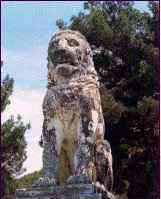
The old bridge over the Strymon is guarded by the Lion of Amphipolis statue; the colossal animal, reassembled from fragments in 1936-37, has been mounted on a pedestal built on the ancient foundation with blocks of the 2C BC dredged from the Strymon, where they may have been reused in a medieval dam. Originally the lion may have honored Laomedon, the sailor of Mytilene who later became the governor of Syria.
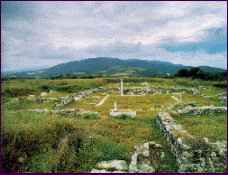
The city of Amphipolis was built on a commanding eminence (154m) above the E bank of the Strymon, just below its egress from Lake Achinos (now drained), ca. 5km from the sea. A loop of the river flowed round the W half of the city walls.
The place, which belonged to the Edonians of Thrace, was originally called "Ennea Odoi" ('Nine Ways'), for which reason, according to Herodotus (VII, 114), Xerxes on crossings its bridges buried alive nine local boys and nine girls. It was colonized as Amphipolis by the Athenians in 437 BC after an abortive attempt 28 years earlier.
Deriving its wealth from the gold mines of the Pagaion mountain, Amphipolis was one of their most important N possessions: hence the consternation when it surrendered to the Spartan Brasidas in 424. The historian (and general) Thucydides saved its port of Eion, at the mouth of the Strymon, but, for failing to save Amphipolis as well, he was exiled for 20 years by his countrymen (Thuc. IV, 104-6; V, 26). In 421 the Athenians made an unsuccessful attempt to retake the city; in the cavalry battle both Kleon, the Athenian demagogue and general, and his opponent Brasidas were killed.
Amphipolis was seized by Philip II of Macedon in 358. After the battle of Pydna (168) it became the capital of one of the four republics provisionally set up by the Romans. St. Paul passed through Amphipolis on his way to Thessaloniki ('Acts,' XVII, 1). The city was a station on the Via Egnatia and the seat of a bishop in the Early Christian period. Excavations have been made since 1956 by the Greek Archaeological Service.
Following the road to Drama, soon (left) there is a small sign in Greek
(Macedonian Tomb). Two tombs lie on the hill right of the road: one had been
plundered but the other yielded precious articles now in Kavala museum. Further
up the road, another sign (left) indicates ancient walls and a short climb above
the road, further sections of the defenses can be seen.
 Substantial remains of a Classical gymnasium have recently been discovered in
this vicinity.
Substantial remains of a Classical gymnasium have recently been discovered in
this vicinity.
After another 300m is the turning (left) for the modern village. On the hill opposite the turn is a Hellenist cemetery of rock-cut tombs. In the village, the church contains a relief of Totoes, the Thracian equivalent of Hypnos. Signs lead, through the village and up the hill, towards the main archaeological area, on the acropolis of the ancient city. The principal remains so far excavated are not of the Classical period but of five churches of the 5 and 6C AD, four basilica and one with hexagonal internal layout. Some of the mosaics (including fine and varied representations of birds) can be seen, protected by wooden shelters; others remain semi-permanently covered.
A short distance further up the track are the remains of a Roman house, again under a shelter to protect its mosaics. It has a paved courtyard with a well in addition to mosaic floors and an apsidal room which originally had painted plaster decoration. Beside the house and not yet fully investigated is a building with statue dedications in front. 100m below these structures, down a track, is a remarkable Hellenistic house (covered) with fine painted decoration employing architectural motifs of the kind which formed the basis for the First Pompeian style. A Shrine of Clio borders a deep ravine to the SE.